One of the questions people sometimes ask before refractive surgery is whether the procedure could also alter the appearance of their eyes. If you are wondering “Can Laser Eye Surgery Change Your Eye Color?”, it is important to distinguish between the structures responsible for vision and those responsible for eye color. At Aziz Ophthalmology in Dubai and Abu Dhabi, explaining what a procedure can and cannot change is an important part of helping patients approach treatment with realistic expectations.

Can Laser Eye Surgery Change Your Eye Color?
The short answer is that conventional laser vision correction does not aim to change your natural eye color. Procedures such as LASIK and PRK work primarily on the cornea, the transparent structure at the front of the eye. The laser reshapes corneal tissue in a controlled way to modify how light is focused onto the retina and thereby correct refractive errors such as myopia, hyperopia or astigmatism. The iris, by contrast, is the colored structure located behind the cornea and in front of the natural lens.
This distinction explains why searching Laser Eye Surgery Change Your Eye Color can sometimes lead to confusion. The word “laser” describes a technology that can be used for very different medical purposes, but this does not mean that every laser procedure acts on the same ocular tissue. During standard refractive laser surgery, the objective is to alter the focusing characteristics of the cornea, not the pigmentation of the iris. A patient may notice that the eyes look slightly different temporarily because of redness, dryness, lighting or pupil size, but these observations should not be confused with an intended permanent change in iris pigmentation. If an unexpected alteration in eye appearance develops, it deserves an ophthalmic assessment rather than assumptions about its cause.
What determines the natural color of your eyes?
The visible color of an eye is mainly associated with the iris, the circular structure surrounding the pupil. Its appearance depends on factors including pigmentation and the way light interacts with the iris tissue. This is why eyes can appear brown, hazel, green, blue or somewhere between these commonly used descriptions. The pupil itself is not colored tissue: it is the opening at the center of the iris through which light enters the eye.
The cornea sits in front of these structures and is transparent. It plays an essential optical role because it provides much of the eye’s focusing power, but it does not determine whether an individual’s iris is brown, blue or another color. This anatomical difference is particularly useful when understanding refractive surgery. Changing the shape of the cornea changes its focusing power, whereas changing natural eye color would require affecting structures or pigmentation associated with the iris. They are therefore two very different objectives. Lighting conditions can also make the same iris appear somewhat different because the pupil changes size and because colors are perceived differently under varying illumination. This normal visual effect does not mean that the pigmentation itself has changed.
How does laser eye surgery work without affecting eye color?
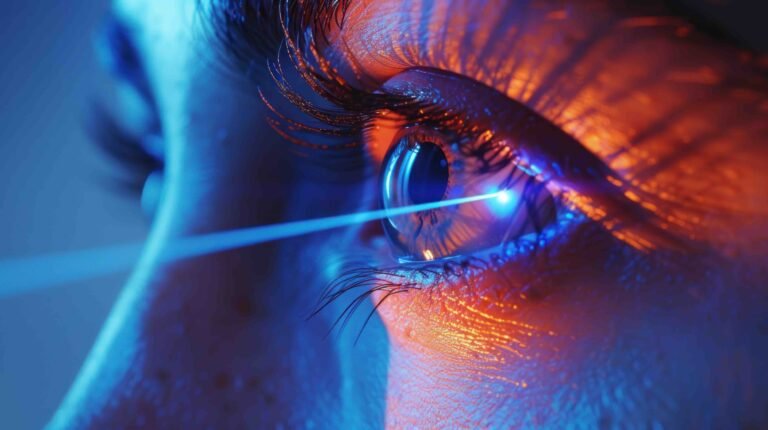
Laser vision correction is designed to address refractive errors by modifying the shape of the cornea. In LASIK, access is created to the underlying corneal tissue and an excimer laser reshapes a precisely determined area. In PRK, the approach to the corneal surface is different, but the fundamental objective remains similar: changing corneal curvature so that incoming light can be focused more appropriately on the retina. The treatment therefore concerns optical focusing rather than cosmetic pigmentation.
Before considering laser correction, careful measurements are needed to understand the patient’s prescription, corneal characteristics and general ocular health. At Aziz Ophthalmology, the initial assessment helps establish whether laser treatment is appropriate in the first place. Not every eye is suitable for the same procedure, and if LASIK is not considered the right choice, another approach may be discussed depending on the individual situation. This is also why laser vision correction should never be understood as a generic cosmetic laser treatment. Its purpose is functional: reducing refractive error and, in suitable patients, reducing dependence on glasses or contact lenses. The iris remains a separate anatomical structure from the corneal tissue being reshaped.
Why can your eyes sometimes look different after laser surgery?
Some patients may feel that their eyes look slightly different during the period following treatment, even though their natural iris color has not intentionally been altered. Several simple factors can influence this impression. Lighting is one of them: pupil diameter changes according to illumination, exposing different proportions of the iris and potentially making its color appear lighter or darker. The appearance of the ocular surface can also temporarily influence how someone perceives the eye when looking closely in a mirror.
Temporary symptoms following refractive surgery may include dryness, irritation or visual phenomena such as glare and halos, and recovery varies according to the procedure and the individual patient. These effects concern healing and visual quality rather than a planned alteration of iris pigmentation. It is therefore important not to rely on photographs, social media comparisons or changes noticed under different lighting conditions to decide whether the eye has genuinely changed color. If one eye suddenly appears different from the other, or a change in appearance is accompanied by pain, redness, reduced vision or another unusual symptom, an ophthalmologist should evaluate the eye. Attempting to diagnose an ocular change from photographs or online information can overlook conditions that require proper examination.
Can laser eye surgery make brown eyes blue?
Standard refractive procedures such as LASIK or PRK are not performed to turn brown eyes blue or to produce another cosmetic eye color. Their clinical purpose is different: the laser acts on corneal tissue to modify refractive power. Brown pigmentation, meanwhile, is associated with the iris. For this reason, expecting conventional laser vision correction to produce a predetermined cosmetic change in iris color would misunderstand how the procedure works.
It is also useful to distinguish established refractive treatments from procedures or techniques promoted specifically for cosmetic eye-color alteration. They should not be considered interchangeable simply because a laser or another ophthalmic intervention may be involved. Any procedure that intentionally interacts with ocular structures for aesthetic purposes has its own mechanism, potential complications and suitability considerations. Changing the appearance of a healthy eye is not equivalent to correcting myopia or astigmatism, and information found online should not replace a medical assessment. Patients interested in refractive surgery should focus primarily on whether their eyes are suitable for vision correction, what level of correction may reasonably be expected and what risks or limitations apply to their individual case.
What does laser eye surgery actually change?
The objective of laser eye surgery is to modify the way the eye focuses light, rather than to change how the eye looks. Myopia occurs when light does not focus appropriately on the retina for clear distance vision; hyperopia affects focusing in a different way, while astigmatism is associated with irregularities in the optical system that can cause blurred or distorted images. By carefully reshaping the cornea, refractive surgery can alter its focusing power and potentially reduce dependence on corrective lenses.
Different patients require different evaluations and treatment strategies. At Aziz Ophthalmology, available refractive options include Femto-LASIK, Standard LASIK and PRK/Trans-PRK, alongside other refractive solutions for patients whose characteristics may call for a different approach. Before surgery, measurements and diagnostic examinations are therefore fundamental. Corneal topography and tomography, refraction and other ocular assessments can help determine whether treatment is appropriate and which technique may be considered. The objective is not to alter the iris, pupil or natural aesthetic identity of the eye. It is to address a visual refractive problem through a treatment selected according to the patient’s ocular characteristics.
Can everyone have laser eye surgery?
No. Although laser vision correction can be considered by many people who have refractive errors, suitability must be established individually. The condition and thickness of the cornea, stability of the prescription, ocular surface health and the presence of particular eye diseases are among the factors that can influence the decision. Keratoconus, for example, requires particular attention because it affects the shape and structure of the cornea. Dry eye and other ocular conditions may also need to be evaluated before proceeding.
This is one reason why do-it-yourself assessments or online eligibility tests cannot determine whether someone should undergo surgery. A professional examination provides measurements that cannot be obtained simply by knowing your glasses prescription. At Aziz Ophthalmology, patients are assessed before meeting Dr. Hassan Abdul Aziz so that the characteristics of their eyes can be studied carefully. If LASIK is not appropriate, this does not automatically mean that no alternative exists: depending on the individual case, another refractive technique or solution may be considered. The decision should always start from ocular health and realistic visual goals, rather than from the expectation of achieving a particular cosmetic appearance.
Laser Eye Surgery Change Your Eye Color: what should you remember?
If you have searched for Laser Eye Surgery Change Your Eye Color, the most important distinction to remember is anatomical: conventional refractive laser surgery works on the cornea to change its focusing properties, while natural eye color is associated with the iris. LASIK and PRK are therefore designed to address refractive errors, not to cosmetically change iris pigmentation.
Understanding this difference also helps patients approach laser vision correction with more realistic expectations. The important questions are whether your refractive error can be treated, whether your corneas and eyes are suitable for surgery, which technique may be appropriate and what results and limitations can reasonably be expected in your individual case. At Aziz Ophthalmology, these aspects can be explored through a complete ophthalmic assessment and a clear discussion of the available options.
📞 +971 58 518 4688
💬 +971 58 518 4688
✉️ azizophthalmology@gmail.com
📍 Emirates Hospital Jumeirah, Dubai / Harley Street Medical Center, Abu Dhabi