Vision is a gift we often take for granted until we begin to perceive that something about how we observe the world is slowly changing. When it comes to ocular health, one of the most common conditions linked to natural aging is a cataract, which consists of the progressive clouding of the crystalline lens. Many patients I meet daily at my clinic, which operates in Dubai and Abu Dhabi, often ask: “What Are the First Signs of Cataracts?” As a specialist in cataract Surgery in Dubai and Abu Dhabi, I know that recognizing the initial signals is fundamental, as timely awareness allows for the planning of the most suitable treatment path, without reaching a stage where impaired vision limits the quality of life. My mission as a doctor is to provide clear, clinically-based answers that help everyone understand their visual health with serenity and competence.

How Does the Onset of a Cataract Visually Manifest?
The process of lens clouding almost never happens suddenly; it is a gradual evolution, so slow that the brain often learns to adapt to visual changes without the patient initially realizing it. The first signal many notice is a sort of light mist or a slightly blurred vision, as if looking constantly through a slightly dirty or fogged glass. This is not blurriness correctable with stronger glasses; it is a lack of sharpness that does not improve by changing the lens prescription. Often, this condition makes images less defined, and details both at a distance and up close gradually lose that contrast that made them distinguishable.
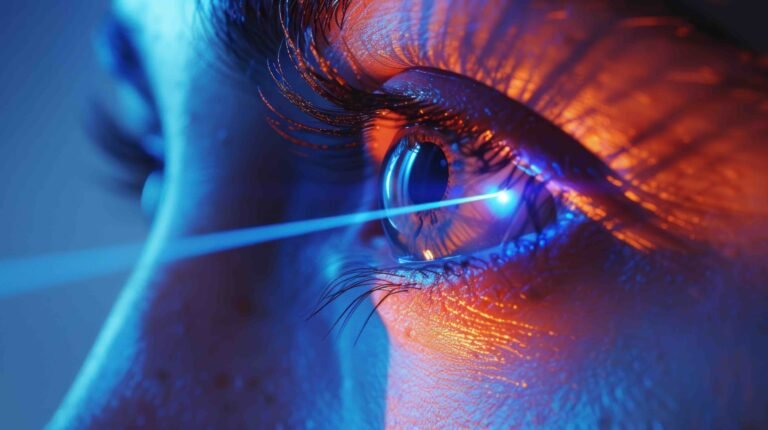
Another very frequent signal, especially for patients who frequently drive through the intense lights of Dubai and Abu Dhabi, is an increase in sensitivity to glare. Lights from streetlamps, oncoming car headlights, or the sun reflecting off the asphalt begin to create light halos or annoying glares that can make night vision particularly uncomfortable. The lens that is becoming opaque scatters light instead of focusing it correctly, causing this “scattering” effect that disturbs sharpness. Noticing this difficulty is one of the most direct ways to understand that the lens is losing its original transparency and that it is appropriate to schedule a specialist check-up.
Why Does Color Perception Change Over Time?
Beyond sharpness, a symptom patients report with surprise is the change in the vibrancy of colors. Over the years, the lens developing a cataract tends to yellow or turn brownish, acting as a sort of internal color filter. This process transforms color perception: cool tones, such as blue and violet, appear less brilliant, while warm tones, such as yellow and red, become dominant. It is common to hear patients exclaim after cataract surgery that the world suddenly seems “brighter” and colors more realistic; this happens because the opaque lens was finally replaced by a perfectly transparent artificial lens.
This change is so slow that the patient does not notice the transformation at all, unless they try to compare their ocular perception with that of a healthy eye or recall how objects appeared years earlier. At Aziz Ophthalmology, we use specific tests to evaluate not only the ability to read charts but also contrast sensitivity, a parameter that helps identify cataracts even when visual acuity seems apparently acceptable. It is fundamental not to wait until vision becomes a disabling problem before undertaking a serious clinical conversation regarding the state of the lens.
Can Cataracts Be Confused with Other Visual Defects?
Yes, cataracts are often initially confused with simple myopia or worsening presbyopia. It is common for a patient to arrive for a visit complaining that their reading glasses are no longer effective, or that they have to change their lens prescription often. In an early phase, the clouding of the lens can even induce a so-called “second sight,” where the patient is momentarily able to read better up close without glasses. However, this is almost always a warning signal indicating a physical change in the eye’s lens and not a real improvement in visual health.
An expert ophthalmologist in Dubai must be able to distinguish between a simple physiological dioptric variation and the onset of an incipient cataract. Not being misled by these changes is crucial. If you notice you have to change glasses with unusual frequency, you should not limit yourself to a new eye test at an optical center, but you should request an evaluation of the anterior segment of the eye. Only a slit-lamp examination performed by a specialist can confirm if the lens is actually losing its transparency. A precise diagnosis avoids unnecessary expenses for glasses that will never be fully satisfactory and puts the patient in a position to know the real nature of their visual problem.
When Does Surgery Become the Most Effective Solution?
Many patients who turn to Aziz Ophthalmology ask me: “Do I have to wait for the cataract to be mature?” The clinical answer is a definite no. With modern lens surgery, there is no medical advantage in waiting for the cataract to become dense and hard. On the contrary, operating when the cataract is in the early or intermediate phases allows for the use of lower ultrasonic energy for breaking up the lens, making the procedure faster, less traumatic for the ocular structures, and ensuring an even faster post-operative recovery. The decision to operate must be shared and dictated by the impact that visual decline has on your life.
If blurred vision starts to make driving, working, reading documents, or managing daily activities difficult, it is time to seriously consider surgery. There is no universal “cataract level” to decide on the operation; the limit is set by your visual needs. Dr. Hassan Abdul Aziz discusses with every patient the available intraocular lens options, which today allow for correcting even pre-existing defects like astigmatism or presbyopia, offering in many cases a visual quality better than what the patient had before the onset of the cataract itself. Modern technology allows for customizing the result in a nearly tailored way.
What Does the Intervention Entail and What Are the Recovery Times?
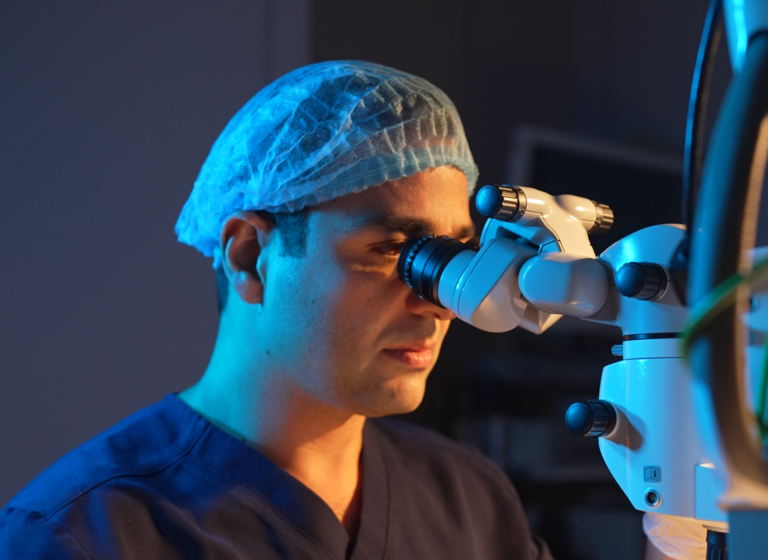
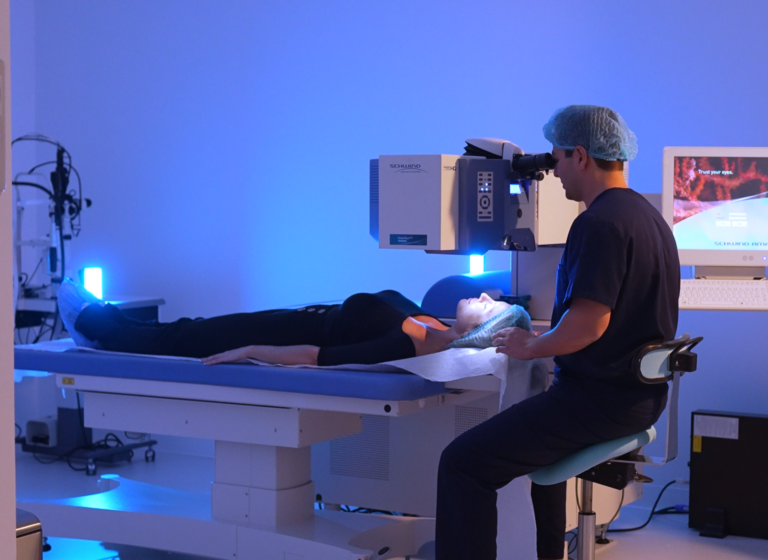
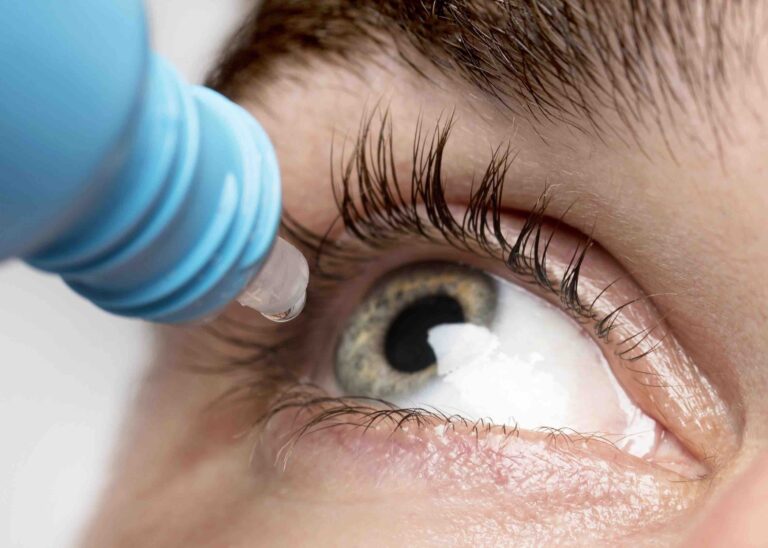
The procedure of replacing the opaque lens with an artificial one is, nowadays, one of the safest and most successful operations in all of medicine. It is a day-surgery intervention, where the patient does not require hospital admission. Thanks to micro-incision techniques, Dr. Aziz performs the operation through an opening of only a few millimeters, which does not require stitches. The intervention usually lasts a few minutes and is performed under local anesthesia, using drops that make the procedure absolutely pain-free. Safety is guaranteed by the excellent surgical environment in which I operate, both in Dubai and Abu Dhabi.
Recovery is, in most cases, very fast. Just a few hours after the operation, the patient can begin to perceive the first benefits of the new transparent lens. It is necessary to observe some basic precautions, such as avoiding intense physical exertion and protecting the eye from bumps or contamination in the first few weeks, meticulously following the topical therapy with antibiotic and anti-inflammatory eye drops. The speed with which one returns to normal daily activities is one of the aspects that most surprises patients, who often regret only not having faced the problem earlier.
What Are the First Signs of Cataracts? The Commitment to Clear and Lasting Vision
At Aziz Ophthalmology, cataract monitoring is never left to chance. The health of the lens is part of the global evaluation that I offer to anyone who turns to the clinic for periodic check-ups. It does not matter what your age or visual defect is; prevention and knowledge of symptoms are the foundations for avoiding reaching severely impaired vision. The clinical approach I adopt is aimed at preserving your independence, ensuring that every moment of your life can be enjoyed with maximum clarity and fullness of detail, eliminating the veil that the cataract inevitably tends to cast over the world.
Relying on those who know the most advanced techniques and apply rigorous professional ethics is the best way to face a problem that, sooner or later, affects almost every individual. If you have noticed one of the signals we discussed, or if you simply feel that your vision is not what it used to be, do not delay. Your vision deserves to be treated with the utmost care. I invite you to contact the clinic for an in-depth consultation, where we can analyze your case and define together the safest and most effective strategy to preserve your visual heritage.
📞 +971 58 518 4688
💬 +971 58 518 4688
✉️ azizophthalmology@gmail.com
📍 Emirates Hospital Jumeirah, Dubai / Harley Street Medical Center, Abu Dhabi